Free tool
Incline dumbbell bench press 1RM calculator
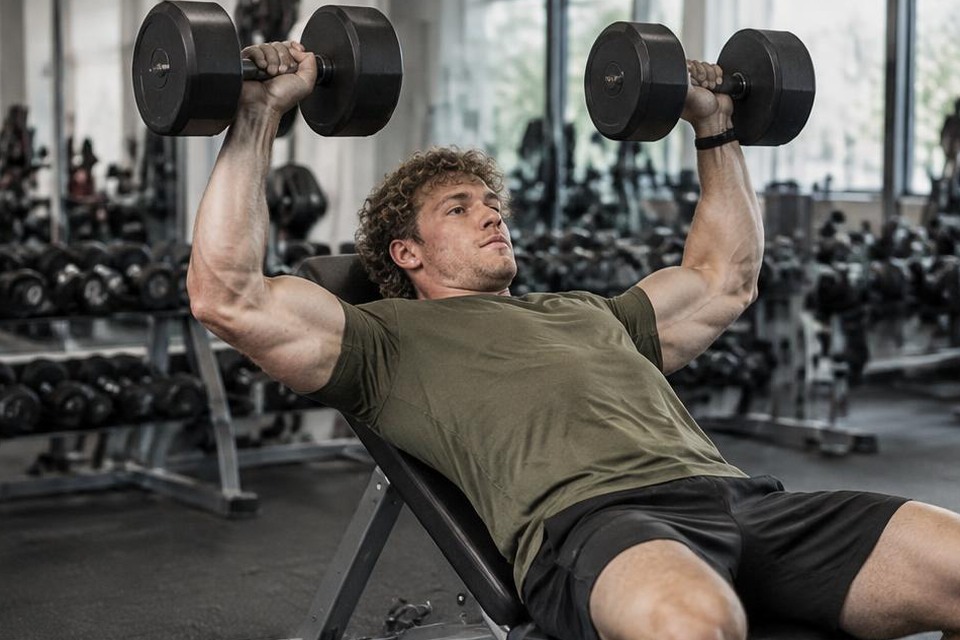
Turn a completed set of incline dumbbell presses into an estimated one-rep max and working weights per dumbbell. Keep the same bench angle and depth when comparing sessions.
Evidence-checkedEdited by Chris Mann Dip.IOPNHow we check thisClose
Every figure and rating this tool shows comes from one set of tested rules, the same ones used across the Hub and our AI tools, with the method and sources named on the page.
Advertising never decides what we write or recommend. If something is wrong, we correct it and record the change.
Short answer: Enter a set you have completed and how many more reps you could have done. For example, 8 reps at 28 kg per dumbbell with 1 rep in reserve estimates a incline dumbbell bench press one-rep max of about 36.4 kg per hand (Epley equation). Use the working-weight table as a starting point, not a target to attempt.
Enter the weight of one dumbbell, not the pair. Use a set where the bench angle stayed the same and every rep came down under control to the same depth. Dumbbells are awkward to test for a single rep, so use the table to pick working weights and round to the nearest dumbbell your gym has.
A set you have already done
Estimated one-repetition maximum
29.3 kg
29.3 kg
From 22 kg × 8 reps at 2 RIR (Epley)
Save this estimated 1RM as my best (29.5 kg) — kept on this device for the warm-up, strength standards, DOTS and percentage tools.
| Reps | 0 RIR | 1 RIR | 2 RIR | 3 RIR |
|---|---|---|---|---|
| 3 | 26.6 kg | 25.9 kg | 25.1 kg | 24.4 kg |
| 5 | 25.1 kg | 24.4 kg | 23.8 kg | 23.1 kg |
| 8 | 23.1 kg | 22.5 kg | 22 kg | 21.4 kg |
| 10 | 22 kg | 21.4 kg | 20.9 kg | — |
| 12 | 20.9 kg | — | — | — |
A warm-up ramp to 22 kg (8 reps, 2 in reserve)
| Set | Weight | Each side |
|---|---|---|
| Working | 20 kg | bar only |
Roughly 40, 55, 70 and 85 per cent of the working weight, for a few easy reps each, then the working set. A general guide, not a prescription — add or drop steps to suit the lift and how you feel.
Uses the Epley equation, counting reps in reserve as reps you could have done. It is only an estimate from a set you have already completed, not a test of your maximum; a dash means the combination is outside the range the equation is reliable over. Round to the nearest weight your equipment allows.
How to estimate your incline dumbbell press 1RM (per dumbbell)
Enter the weight of one dumbbell, not both together. The incline dumbbell press calculator returns an estimated max and working weights per hand. Use a set performed with the same bench angle and controlled depth.
The Epley equation counts your completed reps plus reps in reserve. It is a planning estimate rather than an exact prediction, and getting heavy dumbbells into position can limit performance separately from pressing them.
Bench angle: 30 degrees vs 45 degrees for upper chest
Bench angle changes the pattern of muscle activation. Lauver et al. (2016) and Rodríguez-Ridao et al. (2020) studied barbell bench pressing at different inclines and found angle-dependent differences in pectoral and anterior-deltoid activity.
These EMG studies do not establish one universally optimal dumbbell angle, prove greater long-term muscle growth or demonstrate reduced injury risk. Treat 30° and 45° as distinct setups, choose a comfortable one, and keep it consistent when tracking your incline dumbbell bench press.
Incline dumbbell press vs barbell bench press: load ratio
Adding both dumbbells together does not create a reliable conversion to flat barbell bench strength. Bench angle, range of motion, stability and familiarity all affect the comparison. No fixed percentage is used here.
Track barbell bench press 1RM independently. The dumbbell-to-barbell converter gives a separate planning estimate, not a guarantee that you can lift that load.
Managing fixed dumbbell weight jumps in progressive overload
If the next dumbbell is a large jump, build reps at your current weight within your planned range before increasing load. Keep depth and effort comparable; use the working-weight table as a starting point and select an available dumbbell rather than assuming a fractional load exists.
Use the double progression calculator to compare your completed reps with your chosen progression range.
Frequently asked questions
Do I enter the weight of one dumbbell or both together?
What is the best bench angle for incline dumbbell presses?
Why is my incline dumbbell press lower than flat dumbbell bench press?
What is a good incline dumbbell press weight?
Should I drop the dumbbells to the floor after a heavy set?
References
- Lauver JD, Cayot TE, Scheuermann BW (2016). Influence of bench angle on upper extremity muscular activation during bench press exercise. European Journal of Sport Science. doi:10.1080/17461391.2015.1022605.
- Rodríguez-Ridao D et al. (2020). Effect of five bench inclinations on the electromyographic activity of the pectoralis major, anterior deltoid, and triceps brachii during the bench press exercise. International Journal of Environmental Research and Public Health. doi:10.3390/ijerph17197339.
Got your incline dumbbell bench press estimate? Try the next lift.
Leg Press 1RM calculator →Something feels off in the incline dumbbell bench press itself? Get one technique cue for your next incline dumbbell bench press set.
Wondering whether this lift is keeping up with the others? Compare your lifts with the lift ratio calculator, or score your total with the DOTS and Wilks calculator.
Picking effort rather than weight? Use the RPE and RIR calculator.
Got your working weight? Work out your warm-up sets and plates. See your lifts as a multiple of your bodyweight, or score a competition total with IPF GL points.
Embed this calculator on your website
Free for coaches, gyms and writers. Paste this code into your page; it stays up to date automatically.
How the calculation works
The Epley estimate is load × (1 + effective repetitions ÷ 30). Effective repetitions are completed reps plus reps in reserve: the extra reps you believe you could have completed with the same technique. A single rep with none in reserve is returned as the entered load. The working-weight table rearranges the same equation for each target.
Worked example
A completed set of 100 kg for 8 reps with 2 reps in reserve gives 10 effective repetitions. The calculator returns an estimated one-rep max of 133.3 kg. This is a calculation example, not a recommendation to attempt that weight.
What the result cannot tell you
Repetitions plus reps in reserve must be 12 or fewer. An estimate is not a tested maximum: technique, fatigue and the accuracy of your RIR estimate affect it. Keep comparisons to the same exercise, equipment and range of motion, and round working weights to what you can load.
Common questions
Do I need to test my maximum?
No. Enter a set you have already completed. The result estimates a maximum without requiring a maximal attempt.
Why is there a dash in the table?
That target's reps plus reps in reserve exceed the calculator's supported range. The tool leaves it blank rather than showing an unsupported estimate.
What does 2 RIR mean?
You believe you could have completed about two more full reps with the same technique. It is a subjective estimate, not a measured fact.

Chris Mann Dip.IOPN is a sports nutritionist, qualified personal trainer and founder of The Muscle & Strength Hub, with six years of experience helping people build muscle, develop strength and improve their nutrition.
- Dip.IOPN
- PN Level 1
- Level 4 Nutrition
- Level 3 PT
Certificates and full profileEditorial independenceCorrections
Share this calculator
Was this tool helpful?
Educational information for adults aged 18 and over. It does not diagnose, treat or manage any medical condition. If you have a health condition, or symptoms that worry you, speak to your doctor or a health professional.