Free tool
Head-to-head exercise comparison tool
Compare two gym exercises side by side and see which one suits your goal, your gym and how your body feels today.
Evidence-checkedEdited by Chris Mann Dip.IOPNHow we check thisClose
Every figure and rating this tool shows comes from one set of tested rules, the same ones used across the Hub and our AI tools, with the method and sources named on the page.
Advertising never decides what we write or recommend. If something is wrong, we correct it and record the change.
Short answer: Pick two exercises to compare their main and helping muscles, equipment, lower back loading, stability and skill. You then get plain reasons to choose each one, so you can pick the lift that fits your goal.
Popular comparisons
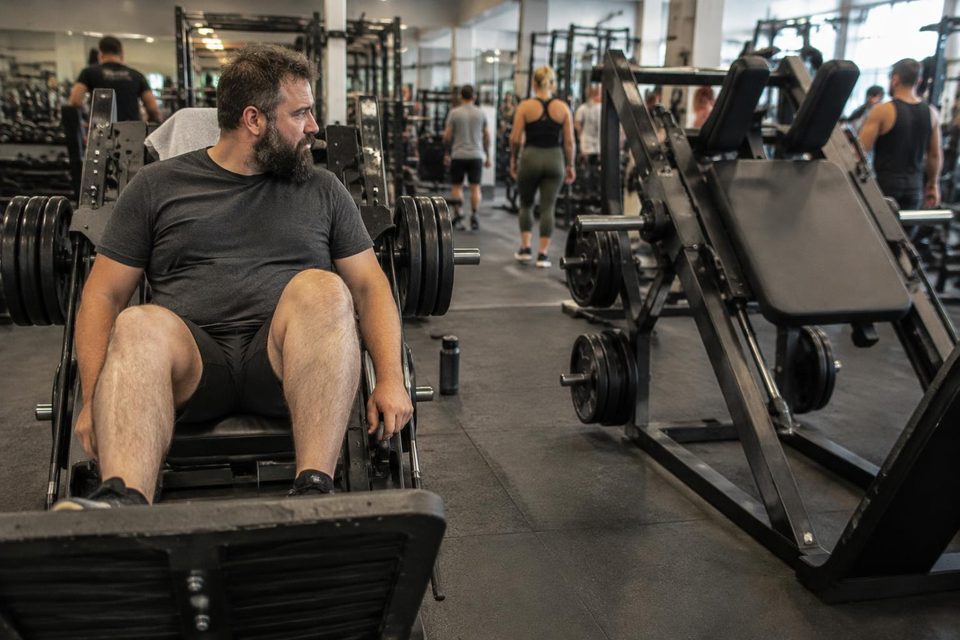
Both are squat exercises and both mainly train the quadriceps, so either can fill the same slot in your plan.
| Factor | Hack squat machine | Leg press |
|---|---|---|
| Movement pattern | squat | squat |
| Main muscles | Quadriceps | Quadriceps, Glutes |
| Helping muscles | Glutes | Adductors |
| Equipment | machine | machine |
| Lower back (spinal) loading | Moderate | Low |
| Stability | Fixed path (machine guides it) | Body braced on a pad or seat |
| Skill to learn | Low | Low |
| Adding weight | Jumps to the next pin on the stack | Jumps to the next pin on the stack |
Choose the hack squat machine if…
- you want the whole body, including your trunk, to work hard together
Shoulder pads carry the load along a fixed track, with your back against a pad.
Choose the leg press if…
- your lower back is tired, or you already do heavy squats or deadlifts that week
- you want glutes to be a main target
You sit with your back on a pad and push a sled, so nothing rests on your shoulders.
Side-by-side exercise comparison: how to choose between similar lifts
No exercise is best for everyone. Each one trades off how directly it trains a muscle, how tiring it is for the rest of the body, how much skill it takes and what equipment it needs. The right choice depends on your goal, your gym and how your joints feel.
Key comparison factors: target muscles, stability and fatigue
- Main and helping muscles: which muscles do most of the work, and which assist.
- Lower back (spinal) loading: a bar on your back or in your hands loads the spine; a leg press or chest-supported row barely does. Doing several heavy high-loading lifts in one session often makes your lower back the limit before your target muscles.
- Stability: machines and pads hold you in place, so you can push sets close to failure without balance letting you down. Free weights also train balance and control.
- Skill: barbell squats and deadlifts take time to learn; machines are quick to pick up.
- Adding weight: barbells allow very small steps; dumbbells and stacks jump in bigger steps.
Free weights vs machines: what the research says
A 2023 systematic review found no meaningful difference in muscle growth between free-weight and machine training (Haugen et al., 2023). Each type tended to improve strength most on the equipment people trained with. Read free weights vs machines for the full evidence.
Popular exercise comparisons
- Hack squat vs leg press: both take load off the spine compared with a barbell squat; the hack squat puts the load on your shoulders along a track, while the leg press keeps your back on a pad.
- RDL vs deadlift: the deadlift starts from the floor and trains the whole back of the body heavily; the Romanian deadlift focuses on the hamstrings and glutes. RDL vs deadlift guide.
- Front squat vs back squat: the front squat keeps you more upright with more quad focus; the back squat lets you lift more and uses more hip drive.
- Chin-ups vs pull-ups: an underhand grip lets the biceps help more; an overhand grip leaves more of the work to the back.
- Seated vs lying leg curl: what the training studies found.
- Overhead extension vs pushdown: the triceps comparison.
How to choose the right exercise for your goals
For muscle growth, pick the version you can train hard, with good form, and add weight or reps to over time. For strength in a specific lift, practise that lift. If equipment is busy, the exercise substitute finder gives three matched swaps.
Frequently asked questions about choosing exercises
Is one exercise always better than another?
Can I do both exercises in the same week?
Why do barbell lifts feel more tiring than machines?
Can I replace barbell squats with the leg press or hack squat?
How often should I change my exercises?
Is this comparison based on research?
Share this calculator
Was this tool helpful?
Educational information for adults aged 18 and over. It does not diagnose, treat or manage any medical condition. If you have a health condition, or symptoms that worry you, speak to your doctor or a health professional.