Free tool
Exercise muscle activation explorer: what muscles each lift works
Choose a lift to see its main movers, helpers, stabilisers and opposing muscles.
Evidence-checkedEdited by Chris Mann Dip.IOPNHow we check thisClose
Every figure and rating this tool shows comes from one set of tested rules, the same ones used across the Hub and our AI tools, with the method and sources named on the page.
Advertising never decides what we write or recommend. If something is wrong, we correct it and record the change.
Short answer: Muscles can be agonists (main movers), synergists (helpers), stabilisers (which hold joints steady) or antagonists (which oppose a joint action). In a bench press the chest is a main mover, the front shoulders and triceps help, and the biceps oppose elbow extension. Opposing muscles may also co-contract rather than simply switch off.
Explore the movement
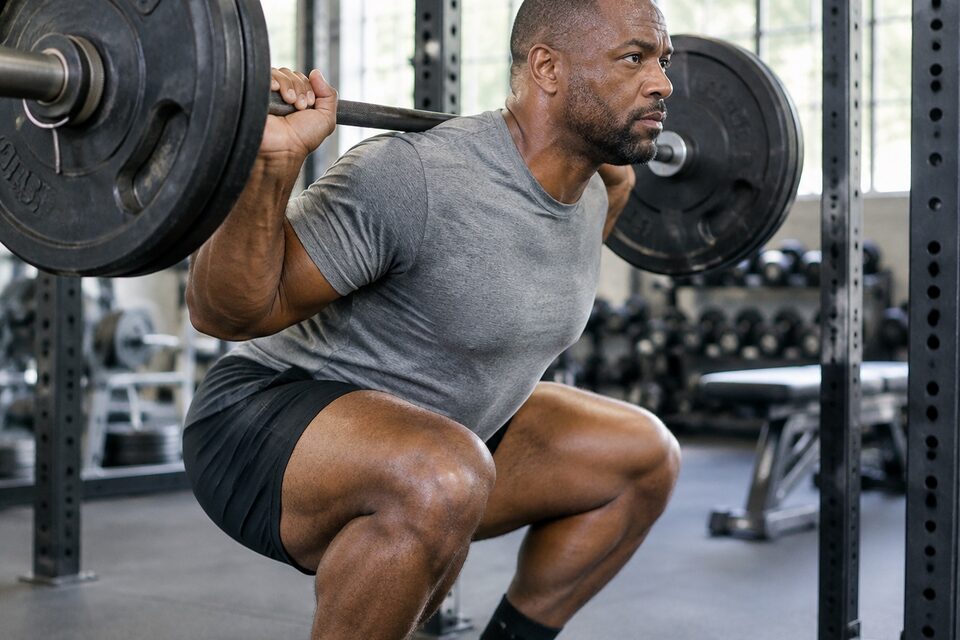
Back squat: Knee and hip straighten as you stand up.
Main movers (agonists)
Quadriceps
Rectus femoris and the three vasti
Straightens the knee; rectus femoris also lifts the thigh.
1Main movers (agonists)
Do most of the work to move the weight.
2Helpers (synergists)
Assist the main movers through the same movement.
3Stabilisers
Hold joints and the trunk still so force reaches the bar.
4Opposing muscles (antagonists)
Oppose the main joint action; they may reduce activity or co-contract to control the joint.
No separate region shown.
Because the hamstrings both bend the knee and straighten the hip, they oppose the quads at the knee while helping the glutes at the hip, so they are listed as helpers rather than antagonists.
Agonist vs antagonist: the simple version
The agonist is the muscle doing the main job — the biceps when lifting a curl. The antagonist opposes that joint action — the triceps straighten the elbow. Antagonist activity may reduce through reciprocal inhibition, but both sides can also contract together to control the joint. Antagonist does not mean inactive.
These roles describe the movement, not whether a muscle is shortening. When lowering a curl, the elbow flexors can remain active while lengthening to brake the weight. The map simplifies each lift’s main lifting action; it is not a measurement of your individual technique.
Synergists help the agonist, and stabilisers (also called fixators) hold other joints still so the force goes into the bar.
Why the roles matter for your training
Pairing opposing muscles. Because a press and a row use opposite muscles, you can alternate them (paired or "superset" sets) and rest one side while the other works.
Muscles can swap roles. The hamstrings oppose the quads at the knee but help the glutes at the hip, so in a squat they are helpers. A muscle's role depends on the movement, not the muscle.
Antagonists still matter. They gently brace the joint as it moves, which is one reason balanced training of both sides is common advice.
Why there are no percentages
Muscle-activity studies (EMG) measure electrical activity, not each muscle's share of a lift, and results change with technique, load and the person. So this tool shows roles, not made-up percentages.
To find which muscle a region covers, use the muscle map. To train a muscle at long lengths, use the muscle-length finder.
Frequently asked questions about agonists and antagonists
What is the difference between an agonist and an antagonist muscle?
What muscles do squats work?
What muscles does the bench press work?
Can a muscle be an agonist and an antagonist?

Chris Mann Dip.IOPN is a sports nutritionist, qualified personal trainer and founder of The Muscle & Strength Hub, with six years of experience helping people build muscle, develop strength and improve their nutrition.
- Dip.IOPN
- PN Level 1
- Level 4 Nutrition
- Level 3 PT
Certificates and full profileEditorial independenceCorrections
Share this calculator
Was this tool helpful?
Educational information for adults aged 18 and over. It does not diagnose, treat or manage any medical condition. If you have a health condition, or symptoms that worry you, speak to your doctor or a health professional.