Free tool
Stance visualiser: deadlift stance width from conventional to sumo
Move your feet wider and watch the pull shorten, the back get more upright and the hip lever shrink — then use the guide to pick the stance that fits your goal.
Evidence-checkedEdited by Chris Mann Dip.IOPNHow we check thisClose
Every figure and rating this tool shows comes from one set of tested rules, the same ones used across the Hub and our AI tools, with the method and sources named on the page.
Advertising never decides what we write or recommend. If something is wrong, we correct it and record the change.
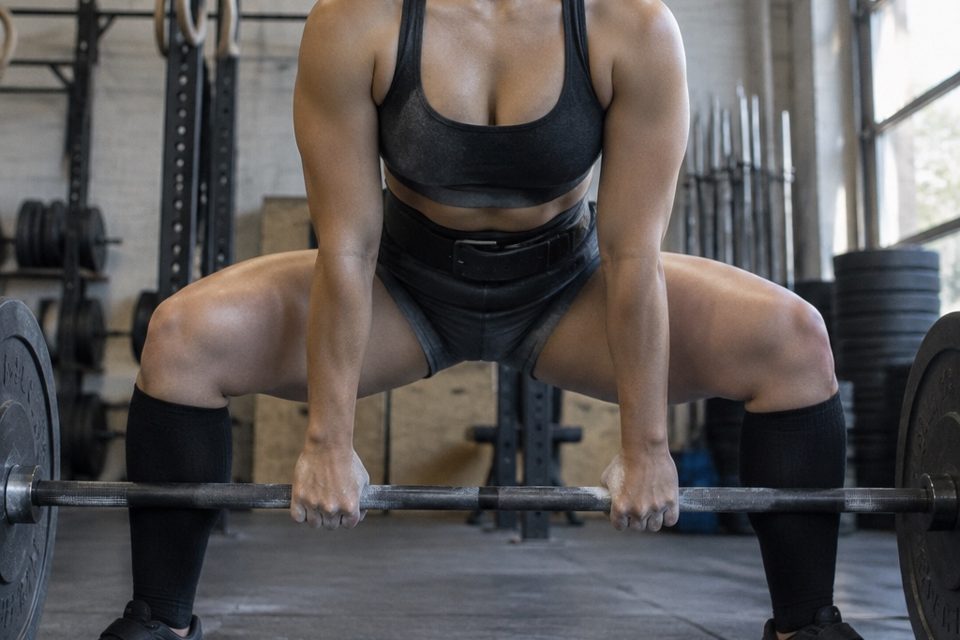
Short answer: A wider stance angles the legs out, which lowers the hips and shortens the pull. Escamilla et al. (2000) found sumo deadlifts had a more upright trunk and shorter bar distance than conventional; conventional asks more of the hips and lower back, sumo more of the thighs.
My lifter profile Set once — every simulator uses it
Enter your proportions once — by hand, from your height, or measured from a photo — and the squat, bench, deadlift, grip and stance tools all start from your body. Kept on this device only; a photo is analysed in your browser and never uploaded.
For a photo: stand front-on in fitted clothes, arms hanging by your sides, whole body in frame, camera at hip height about 3 m away. Phone lenses and clothing can make a length a few centimetres out, so check each figure.
Used by: Squat, Deadlift, Stance
Used by: Squat, Deadlift, Stance
Used by: Squat, Deadlift, Stance
Used by: Deadlift, Stance
Used by: Bench press, Grip
Used by: Grip
Used by: Grip
Used by: Stance
My lifts and gym kit
Best single lifts in kg (a real 1-rep max or the estimate from the 1RM calculator). Leave a box empty if you do not know it — nothing is guessed.
Plates: not set yet — set them once on the plate calculator.
Used by: plate calculator (bar, plates, best lifts), barbell warm-up (bar), strength standards, DOTS/Wilks, RPE/RIR and 1RM calculators. Rounded to 0.5 kg steps.
Average proportions: Winter DA. Biomechanics and Motor Control of Human Movement, 4th ed. Wiley; 2009 (segment lengths after Drillis & Contini 1966). Photo scale uses the same source's eye and ankle heights. A measuring aid, not a body assessment.
Fine-tune limb lengths (51 · 44 · 44 · 59 cm)
Conventional · legs angled out 0°
Feet about hip width, hands outside the legs. Longest pull, more forward lean, more work for hips and lower back.
- Bar pull distance
- 57.5 cm
- Shorter than a narrow stance
- 0 cm
- Hip lever at the start
- 40.7 cm
- Back angle from upright
- 53°
Conventional · 57.5 cm pull
0 cm shorter than narrow · legs out 0°
A simplified geometry model: limb lengths start from average proportions for your height (or your saved lifter profile) and can be fine-tuned; the side view shortens the legs by how far they angle out. Toe angle is shown for knee tracking but not used in the numbers. Not a form check or injury assessment. Calculated by fixed code — no AI.
Choose your stance by goal
Stronger hips and back, or general strength? Conventional (feet about hip width). The longer pull and greater forward lean make the hips and lower back work harder.
More thigh work and less back lean? Sumo or semi-sumo. Escamilla et al. (2002) reported more thigh-muscle activity in sumo; the more upright back reduces the lever on the lower back.
Lifting the most weight? Try both for a few weeks each and keep the one you are stronger in. Long arms and a short torso often suit conventional; a long torso and long thighs often suit sumo — but body type alone does not decide it.
When to use which
If your lower back is the part that is tired the day after, a few weeks of sumo or semi-sumo can share the load with the legs. If your hips feel pinched wide, stay closer. Neither style is safer for everyone.
Whatever the width, turn the toes out until the knees can follow them, and keep the bar over the middle of the foot.
What this model shows
Wider legs angle outward, so they look shorter from the side. The tool shortens the legs by that angle and reuses the deadlift simulator maths to find the start position. It is a simplified picture; real sumo also involves hip rotation that a 2D view cannot show.
Your hand placement is covered in the grip visualiser.
Sources
- Escamilla RF et al. (2000) A three-dimensional biomechanical analysis of sumo and conventional style deadlifts. Med Sci Sports Exerc 32(7):1265–1275.
- Escamilla RF et al. (2002) An electromyographic analysis of sumo and conventional style deadlifts. Med Sci Sports Exerc 34(4):682–688.
- McGuigan MR, Wilson BD (1996) Biomechanical analysis of the deadlift. J Strength Cond Res 10(4):250–255.
Frequently asked questions about deadlift stance
How wide should my deadlift stance be?
Is sumo deadlift easier?
How far should I turn my toes out?
Does this tool tell me which stance is safe?

Chris Mann Dip.IOPN is a sports nutritionist, qualified personal trainer and founder of The Muscle & Strength Hub, with six years of experience helping people build muscle, develop strength and improve their nutrition.
- Dip.IOPN
- PN Level 1
- Level 4 Nutrition
- Level 3 PT
Certificates and full profileEditorial independenceCorrections
Share this calculator
Was this tool helpful?
Educational information for adults aged 18 and over. It does not diagnose, treat or manage any medical condition. If you have a health condition, or symptoms that worry you, speak to your doctor or a health professional.