Free tool
Squat biomechanics simulator: femur length, lean and bar position
Drag the sliders to match your body. The stick figure re-balances over your mid-foot and shows how far you lean and how hard your hips and knees work.
Evidence-checkedEdited by Chris Mann Dip.IOPNHow we check thisClose
Every figure and rating this tool shows comes from one set of tested rules, the same ones used across the Hub and our AI tools, with the method and sources named on the page.
Advertising never decides what we write or recommend. If something is wrong, we correct it and record the change.
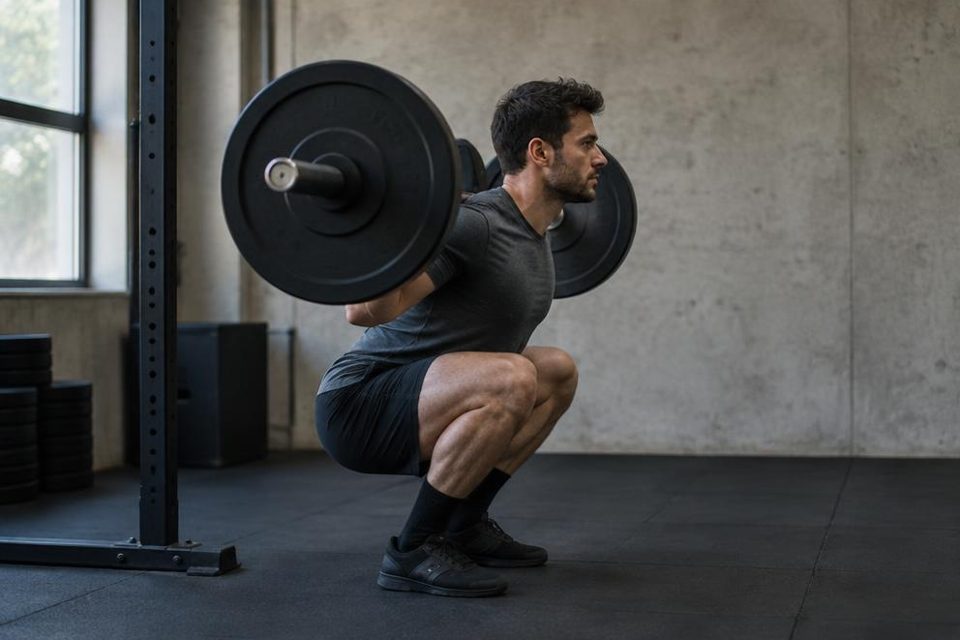
Short answer: Longer thighs relative to your torso and shins push the hips further behind the bar, so you lean forward more and the hips take a bigger share of the load. More knee travel, a wider stance or a high-bar position brings the torso more upright.
Side view at parallel depth. Dot = bar; dashed line = bar over the mid-foot; lines show the hip and knee moment arms.
- Trunk lean
- 26°
- Hip moment arm
- 22 cm
- Knee moment arm
- 22 cm
- Hip : knee
- 1
With 60 kg on the bar: about 129 N·m at the hips and 129 N·m at the knees (bar load only).
Fairly upright torso: the load is shared more evenly between knees and hips.
Ways to sit more upright
- Let the knees travel further forward (more ankle bend), or raise the heels with lifting shoes or a small plate.
- Take a slightly wider stance with toes turned out, which shortens the thigh as seen from the side.
- Use a high-bar position, or a front or goblet squat, which keeps the load further up and forward.
Trunk lean 26°
Hip 22 cm · knee 22 cm moment arm · high bar
A simple 2D lever model, not a motion capture. Real squats also depend on hip structure, mobility and technique. Calculated by fixed code from the figures you enter — no AI.
How femur length affects squat mechanics
To stay balanced, the bar has to stay over the middle of your foot. Your thigh sits horizontal at parallel, so a long femur puts your hips a long way behind the bar. The only way to bring the bar back over the foot is to lean the torso forward.
That lean lengthens the hip moment arm — the horizontal distance from the hip to the bar — so the glutes, hamstrings and lower back do more of the work. A short femur does the opposite: a more upright torso and a more even share between knees and hips.
How to squat with long femurs
Each of these changes the geometry in the simulator, so you can see the effect before you try it:
- Let the knees go forward. A bigger shin angle moves the hips closer to the bar line.
- Raise the heels with lifting shoes or a small plate if your ankles limit knee travel.
- Widen your stance and turn the toes out. Seen from the side, an angled thigh is shorter.
- Try a high-bar, front or goblet squat, which keeps the load higher and further forward.
Leaning forward is not wrong. It is the normal result of your proportions, and you can still build big legs with it.
High bar vs low bar squat: the difference
A low-bar squat sits the bar a few centimetres further down the back, across the rear shoulders. That shorter lever lets you lean further while keeping the bar over the foot, so low bar is usually more forward-leaning and more hip-dominant. High bar sits on the upper traps and is usually more upright and more knee-dominant.
A 2017 review in the Journal of Strength and Conditioning Research (Glassbrook et al.) reported a more upright trunk and greater knee demand in the high-bar squat, and greater hip demand in the low-bar squat. For the full lift-by-lift picture see the exercise comparison tool.
Why do I lean forward when I squat?
Mostly because of your proportions and how far your knees can travel. Fry, Smith and Schilling (2003) showed that stopping the knees from moving forward increased forward lean and raised the hip torque sharply while lowering the knee torque. If you lean more than you would like, check ankle bend first.
What the simulator does and does not model
It is a 2D side-view lever model at parallel depth. Default segment lengths come from standard body proportions (Winter, 2009). Torque uses only the bar load, not the weight of your body segments. It does not account for hip socket shape, mobility, bracing or technique, and it does not judge whether a squat is safe.
Sources
- Winter DA (2009) Biomechanics and Motor Control of Human Movement, 4th edn. Wiley.
- Fry AC, Smith JC, Schilling BK (2003) Effect of knee position on hip and knee torques during the barbell squat. J Strength Cond Res 17(4):629–633.
- Swinton PA et al. (2012) A biomechanical comparison of the traditional squat, powerlifting squat, and box squat. J Strength Cond Res 26(7):1805–1816.
- Glassbrook DJ et al. (2017) A review of the biomechanical differences between the high-bar and low-bar back-squat. J Strength Cond Res 31(9):2618–2634.
Frequently asked questions about squat biomechanics
Is it harder to squat with long femurs?
Should I low-bar or high-bar squat with long femurs?
How do I measure my femur, torso and shin?
What is a moment arm?
Does a wide stance help long femurs?
Is this medical or injury advice?
Share this calculator
Was this tool helpful?
Educational information for adults aged 18 and over. It does not diagnose, treat or manage any medical condition. If you have a health condition, or symptoms that worry you, speak to your doctor or a health professional.