Free tool
Deadlift biomechanics simulator: proportions and starting leverage
Set your torso, thigh, shin and arm lengths. The model finds a conventional-deadlift starting position with vertical arms and the bar over mid-foot, then shows trunk lean and joint moment arms.
Evidence-checkedEdited by Chris Mann Dip.IOPNHow we check thisClose
Every figure and rating this tool shows comes from one set of tested rules, the same ones used across the Hub and our AI tools, with the method and sources named on the page.
Advertising never decides what we write or recommend. If something is wrong, we correct it and record the change.
Short answer: Your proportions constrain how you reach the bar. Longer arms raise the shoulder and often allow a more upright starting trunk in this model; thigh, torso and shin lengths change hip height and the hip and knee moment arms. No single proportion guarantees a stronger deadlift.
My lifter profile Set once — every simulator uses it
Enter your proportions once — by hand, from your height, or measured from a photo — and the squat, bench, deadlift, grip and stance tools all start from your body. Kept on this device only; a photo is analysed in your browser and never uploaded.
For a photo: stand front-on in fitted clothes, arms hanging by your sides, whole body in frame, camera at hip height about 3 m away. Phone lenses and clothing can make a length a few centimetres out, so check each figure.
Used by: Squat, Deadlift, Stance
Used by: Squat, Deadlift, Stance
Used by: Squat, Deadlift, Stance
Used by: Deadlift, Stance
Used by: Bench press, Grip
Used by: Grip
Used by: Grip
Used by: Stance
My lifts and gym kit
Best single lifts in kg (a real 1-rep max or the estimate from the 1RM calculator). Leave a box empty if you do not know it — nothing is guessed.
Plates: not set yet — set them once on the plate calculator.
Used by: plate calculator (bar, plates, best lifts), barbell warm-up (bar), strength standards, DOTS/Wilks, RPE/RIR and 1RM calculators. Rounded to 0.5 kg steps.
Average proportions: Winter DA. Biomechanics and Motor Control of Human Movement, 4th ed. Wiley; 2009 (segment lengths after Drillis & Contini 1966). Photo scale uses the same source's eye and ankle heights. A measuring aid, not a body assessment.
- Hip moment arm
- 40.7 cm · 399 N·m
- Knee moment arm
- 2.6 cm · 26 N·m
- Trunk lean
- 53°
- Bar travelled
- 0 cm
At the start position (bar on the floor)
- Trunk lean
- 53°
- Hip height
- 50.8 cm
- Hip moment arm
- 40.7 cm
- Knee moment arm
- 2.6 cm
With 100 kg on the bar: about 399 N·m at the hips and 26 N·m at the knees from the bar load alone.
Longer arms raise the shoulder and usually make this model more upright, but real deadlift performance also depends on strength, technique and training.
Trunk lean 53°
Hip 40.7 cm · knee 2.6 cm moment arm · 100 kg bar
Leverage across the rep
Sticking point: Lifters most often stall off the floor or around the knees. Off the floor the hip lever is longest in this model; around the knees the bar must travel past the shins and the hips take over.
In-between positions are a smooth geometric path between the start and end positions, with the bar kept over mid-foot (or the forearm vertical on bench). Real reps vary. Torque counts bar load only. Calculated by fixed code — no AI.
A conventional-deadlift model with a 45 cm plate and vertical arms. The movement follows an illustrative geometric path, not a measured lift. It does not model sumo, body-segment weight, acceleration, mobility, bracing or safety. Calculated by fixed code — no AI.
Why body proportions change your deadlift setup
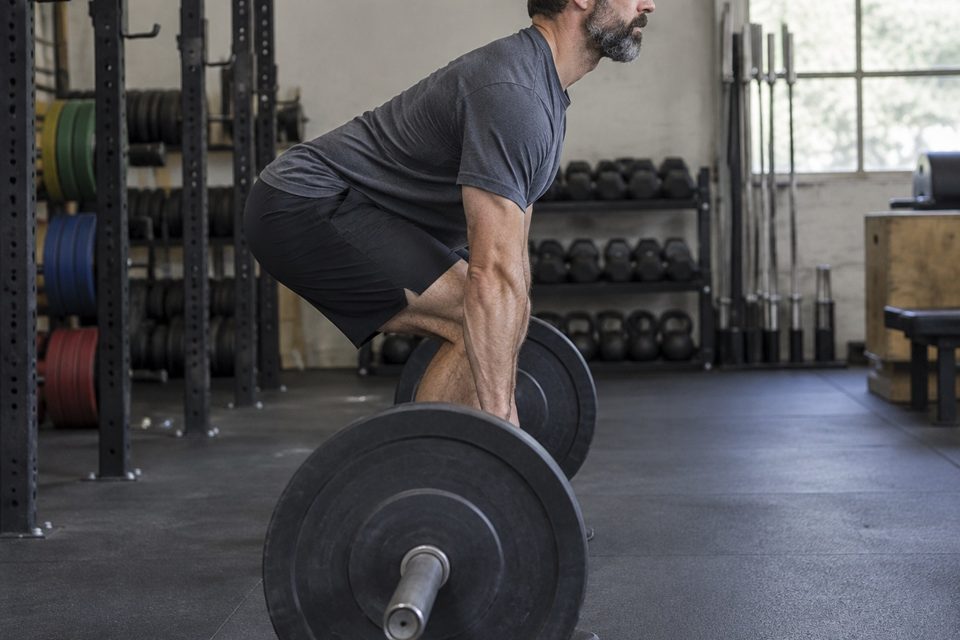
At the start, the bar sits over mid-foot and your arms hang down to it. Your thigh and torso must fit between your knee and shoulder, so changing any segment moves the hip or changes the trunk angle needed to reach the bar.
Longer arms place the shoulder higher above the floor. In this model that usually permits a more upright trunk, while a longer thigh can move the hip backwards or raise it. These are geometric consequences, not instructions to copy someone else’s setup.
Long arms, short arms and deadlift leverage
The horizontal distance from the bar to the hip is the hip moment arm. For the same bar load, a longer distance creates more external hip torque. The knee has its own moment arm, so the picture shows both rather than calling the deadlift only a hip movement.
Research does not support reducing performance to one ‘ideal’ body type. Keith et al. (2023), in a preliminary study of 11 trained men, found no significant overall anthropometric prediction of the measured deadlift outcomes. Use the model to explore positions, not to predict your limit.
What the hip and knee torque figures mean
Torque equals bar load × gravity × horizontal moment arm in metres. It is the external turning effect from the bar alone at this frozen instant. Your muscles must also manage body-segment weight and acceleration, neither of which is included.
Brown and Abani (1985) identified a large hip moment in their adolescent powerlifters, but actual joint demands change as the bar moves. Escamilla et al. (2000) also showed meaningful differences between conventional and sumo lifting, so this conventional-only picture should not be applied to sumo.
Which deadlift variation fits your goal?
Pick the variation by what you want from it, then use the simulator for the conventional start position.
- Conventional: choose it when you want the standard competition-style pull and broad back, hip and leg work. Feet sit about hip width with hands outside the knees.
- Sumo: choose it when a wide stance lets you sit more upright. Escamilla et al. (2000) measured a more upright trunk and a shorter bar path than conventional, with similar overall muscle use. It is a different movement, so this simulator does not model it.
- Romanian deadlift (RDL): choose it when you mainly want hamstring and glute work. You start standing, keep a soft knee and push the hips back to lower the bar to about mid-shin, so the hip does most of the work.
- Stiff-leg deadlift (SLDL): choose it for the same goal as the RDL with less knee bend, which usually means a lighter load and more stretch on the hamstrings.
For grip, a double overhand grip trains your grip and is the simplest starting point. When grip limits heavy sets, a mixed grip (one palm forward, one back) or a hook grip stops the bar rolling; swap which hand faces forward between sets with a mixed grip. Try the widths in the grip visualiser and stance widths in the stance visualiser.
Use the model alongside what you actually do
Start with average proportions or enter rough measurements, then change one control at a time. If no position is possible, the model says so instead of forcing a drawing or inventing a result.
To examine a real repetition rather than a starting-position model, use the private on-device bar-path tracker. To compare conventional and other exercises’ general traits, use the exercise comparison tool.
Sources
- Keith DS et al. (2023) Anthropometric Predictors of Conventional Deadlift Kinematics and Kinetics: A Preliminary Study. Int J Exerc Sci 16(1):429–447.
- Escamilla RF et al. (2000) A three-dimensional biomechanical analysis of sumo and conventional style deadlifts. Med Sci Sports Exerc 32(7):1265–1275.
- Brown EW, Abani K (1985) Kinematics and kinetics of the dead lift in adolescent power lifters. Med Sci Sports Exerc 17(5):554–566.
Frequently asked questions about deadlift biomechanics
Are long arms good for deadlifting?
What is the best hip height for a deadlift?
Does this work for sumo deadlift?
Why does the tool sometimes say no position is possible?
Does a larger hip moment arm mean my back is unsafe?
How the calculation works
The conventional starting model puts a 45 cm plate's centre over mid-foot and hangs the arms vertically from shoulder to bar. The shin angle fixes the knee; the hip is the rear/lower intersection of circles with radii equal to the thigh and torso. Trunk lean and horizontal hip/knee moment arms follow from that position. Torque is bar load × gravity × each moment arm.
Worked example
For a 51 cm torso, 44 cm thigh, 44 cm shin, 59 cm arms and 10° shin angle, the model finds a 53° trunk lean, 40.7 cm hip moment arm and 2.6 cm knee moment arm. A 100 kg bar produces about 399 N·m at the hip and 26 N·m at the knee from external bar load alone.
What the result cannot tell you
Only the conventional starting position is modelled. Sumo, movement after lift-off, body-segment weight, mobility, acceleration, bracing and fatigue are excluded. If the selected segment lengths cannot form the required triangle, the tool reports no possible position rather than forcing one. None of the outputs grades technique or safety.
Common questions
Does this choose my best hip height?
No. It reports the hip position required by the fixed geometry you enter; it does not prescribe an optimal setup.
Can I model a sumo deadlift?
No. Sumo needs different three-dimensional geometry, so this conventional-only model must not be applied to it.
Why are body-segment weights excluded?
The model isolates the external bar's leverage so each slider's effect stays understandable. Real joint demands also include your body segments and motion.
Keith et al. (2023): anthropometric predictors of conventional deadlift mechanics
Chris Mann Dip.IOPN is a sports nutritionist, qualified personal trainer and founder of The Muscle & Strength Hub, with six years of experience helping people build muscle, develop strength and improve their nutrition.
- Dip.IOPN
- PN Level 1
- Level 4 Nutrition
- Level 3 PT
Certificates and full profileEditorial independenceCorrections
Share this calculator
Was this tool helpful?
Educational information for adults aged 18 and over. It does not diagnose, treat or manage any medical condition. If you have a health condition, or symptoms that worry you, speak to your doctor or a health professional.