
Skip to content
Skip to content

Free tool

Lean bulking rate calculator

How fast to gain weight on a lean bulk.

Evidence-checkedEdited by How we check this

Every figure and rating this tool shows comes from one set of tested rules, the same ones used across the Hub and our AI tools, with the method and sources named on the page.

Advertising never decides what we write or recommend. If something is wrong, we correct it and record the change.

Editorial standardsEvidence policyCorrections

Short answer: A practical lean bulking pace is about 0.25 to 0.5% of your bodyweight a week — roughly 0.2 to 0.4 kg a week at 80 kg.

kg
A week
0.18 kg – 0.35 kg
A month
0.8 kg – 1.5 kg
After 12 weeks
72.1 kg – 74.2 kg

Your week-by-week path

Week 12: about 72.1 kg (dashed, slower end) to 74.2 kg (solid, faster end).

Weigh in on a few mornings each week and compare the average with the band. Above the solid line for two to three weeks usually means eating a little less; below the dashed line, a little more.

A practical range to check your weekly average against — 0.25 to 0.5% of bodyweight a week — not a promise of muscle. Gaining faster tends to add more fat; nothing moving for two to three weeks means eat a little more. Your body figures stay on this device and are never sent anywhere.

How much weight to gain per week when bulking

A practical lean bulking pace is 0.25 to 0.5% of your bodyweight a week, about 1 to 2% a month. At 80 kg that is roughly 0.2 to 0.4 kg (0.4 to 0.9 lb) a week. Newer lifters can usually use the upper end; experienced lifters gain muscle more slowly, so the lower end suits them better.

Lean bulk vs dirty bulk

Muscle can only be built so fast. Gaining weight much faster than this range mostly adds fat, which you would later need to diet off. A slower, steady gain keeps more of the weight as muscle.

How to track your rate of gain

Weigh yourself most mornings and compare weekly averages, not single days, because water and food in your gut move the scale from day to day. To set the calories for this pace, use the bulking calorie calculator.

Frequently asked questions about lean bulking

How long should a lean bulk last?

There is no fixed length. Many people run several months, reviewing every few weeks whether the pace and the fat gain still suit them.

What if my weight is not going up after three weeks?

If your weekly average has not moved, add a small amount of food each day, such as a snack, and check again after two more weeks.

Not sure what to eat each day? Work out your target with the bulking calorie calculator.

Scale not moving? Work out what to change.

Find easy extra calories in the bulking foods calorie table.

Need a plan to train on? Download a printable workout plan.

Embed this calculator on your website

Free for coaches, gyms and writers. Paste this code into your page; it stays up to date automatically.

See all embeddable calculators and instructions

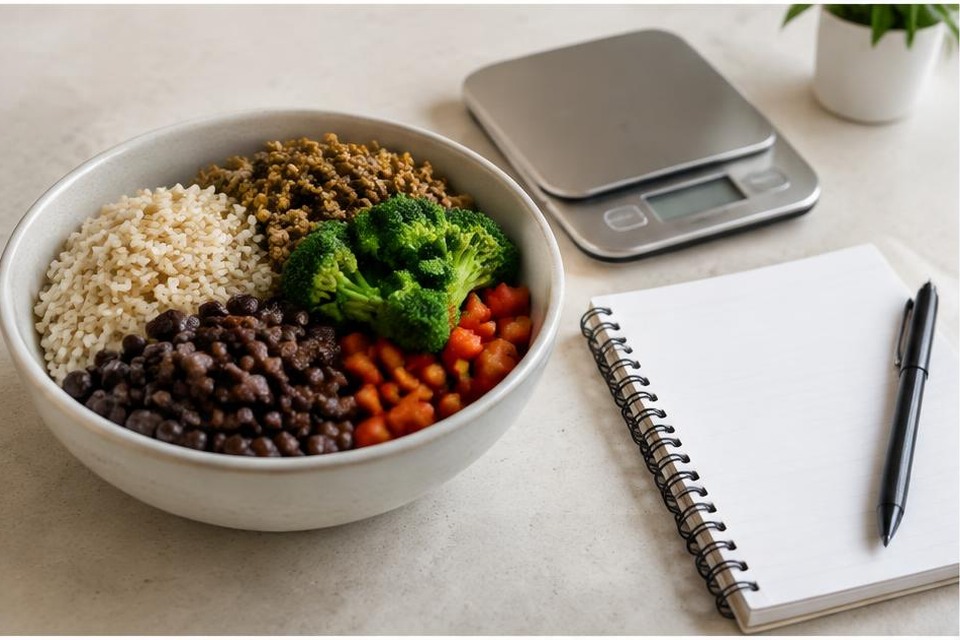
A balanced beef and rice bowl beside scales and a notebook.

How the calculation works

The calculator multiplies starting bodyweight by the lower and upper weekly gain percentages. Monthly figures use 52 ÷ 12 weeks. End weights add the weekly gains to starting weight over the selected duration; the projection does not compound the percentage as weight increases.

Worked example

For a starting bodyweight of 80 kg over 12 weeks, the calculator returns 0.2–0.4 kg per week and 0.9–1.7 kg per month. Its projected end-weight range is 82.4–84.8 kg, not a prediction of muscle gained.

What the result cannot tell you

The range is a practical monitoring guide, not a proven individual optimum or a guarantee of muscle gain. Scale weight cannot separate muscle, fat, water and gut contents. The projection keeps the starting weekly gain fixed and does not model changes in expenditure or adherence.

Common questions

Does the projected gain mean new muscle?

No. It describes total scale-weight gain and does not estimate what that gain is made of.

Why is a month not exactly four weeks?

The calculator uses the average number of weeks per month across a year: 52 divided by 12.

Does the projection recalculate as I get heavier?

No. It applies the weekly gain worked out from your starting bodyweight for the whole period.

Portrait of Chris Mann Dip.IOPN

Written and checked by

Founder & Lead Performance Nutritionist

Chris Mann Dip.IOPN is a sports nutritionist, qualified personal trainer and founder of The Muscle & Strength Hub, with six years of experience helping people build muscle, develop strength and improve their nutrition.

  • Dip.IOPN
  • PN Level 1
  • Level 4 Nutrition
  • Level 3 PT

Certificates and full profileEditorial independenceCorrections

Share this calculator

Free download

Print it or save it to your phone. No email or sign-up. All templates

Free printable · 2 pages · A4

Bulking food reference

Calories and protein for everyday energy-dense foods, from UK government food data, plus a sensible weekly gain.

  • 15 foods with a real portion, calories and protein (CoFID 2021)
  • Weekly weight-gain range for bodyweights from 50 to 110 kg
  • A weekly weigh-in log

Share this template

Was this tool helpful?

Educational information for adults aged 18 and over. It does not diagnose, treat or manage any medical condition. If you have a health condition, or symptoms that worry you, speak to your doctor or a health professional.