
Skip to content
Skip to content

Free tool

Bulking foods calorie table

Calorie-dense everyday foods, with real UK figures.

Evidence-checkedEdited by How we check this

Every figure and rating this tool shows comes from one set of tested rules, the same ones used across the Hub and our AI tools, with the method and sources named on the page.

Advertising never decides what we write or recommend. If something is wrong, we correct it and record the change.

Editorial standardsEvidence policyCorrections

Short answer: The easiest calories to add come from oils, nuts, nut butters, seeds, oats, dried fruit and whole milk: small portions carry a lot of energy.

High-calorie foods for bulking, per 100 g and per typical portion
Foodkcal / 100 gProtein / 100 gTypical portion
Olive oil8990 g1 tablespoon: 126 kcal, 0 g protein
Walnuts68814.7 ga small handful: 206 kcal, 4.4 g protein
Peanut butter, smooth60722.8 g1 tablespoon (approx.): 121 kcal, 4.6 g protein
Mixed nuts58123.8 ga small handful: 174 kcal, 7.1 g protein
Pumpkin seeds56524.4 g2 tablespoons: 170 kcal, 7.3 g protein
Almonds55421.2 ga small handful: 166 kcal, 6.4 g protein
Plain chocolate5105 ga few squares: 128 kcal, 1.3 g protein
Crunchy muesli with nuts4508.4 ga bowl: 225 kcal, 4.2 g protein
Porridge oats, dry38110.9 ga bowl (dry weight): 191 kcal, 5.5 g protein
Pasta, white, dried34311.3 ga large portion (dry weight): 343 kcal, 11.3 g protein
Bagels, plain27310 g1 bagel (approx.): 232 kcal, 8.5 g protein
Raisins2563 ga small box-sized handful: 77 kcal, 0.9 g protein
Dates, dried2352.4 gabout 5 dates: 94 kcal, 1 g protein
Salmon, farmed, grilled23924.6 g1 fillet (approx.): 287 kcal, 29.5 g protein
Avocado (Hass), flesh1711.8 ghalf an avocado (approx.): 120 kcal, 1.3 g protein
Eggs, whole, raw13112.6 g1 medium egg (approx.): 66 kcal, 6.3 g protein
Whole milk633.4 ga large glass (250 ml, approx.): 158 kcal, 8.5 g protein

Figures per 100 g from McCance and Widdowson's Composition of Foods (CoFID 2021), the UK's official food data. Portion sizes are rough everyday amounts, so check the label for the exact product you buy.

High calorie foods for bulking and weight gain

Every figure in the table comes from the UK McCance and Widdowson food composition data. Foods high in fat, such as oils and nut butters, carry the most energy per gram, which is why small portions add up quickly.

Clean bulking foods versus dirty bulking

Whole foods like oats, milk, nuts and dried fruit add calories along with protein, fibre and other nutrients. Relying on mostly sweets and fast food makes the surplus easy but usually crowds out those nutrients.

How to eat more calories when your appetite is low

Choose foods that add energy without much volume, add oil or nut butter to meals you already eat, and drink some calories as milk or smoothies. To set the right total, use the bulking calorie calculator.

Frequently asked questions

What food has the most calories per 100 g?

Oils have the most, because they are almost pure fat. Nuts, seeds and nut butters come next among everyday foods.

Are high calorie foods good for building muscle?

They make a surplus easier to reach, but muscle also needs enough protein and progressive training.

Where do these figures come from?

From the official UK food composition data (McCance and Widdowson), not from estimates or brand labels.

Not sure what to eat each day? Work out your target with the bulking calorie calculator.

Check your pace with the lean bulking rate calculator.

Scale not moving? Work out what to change.

Need a plan to train on? Download a printable workout plan.

Embed this calculator on your website

Free for coaches, gyms and writers. Paste this code into your page; it stays up to date automatically.

See all embeddable calculators and instructions

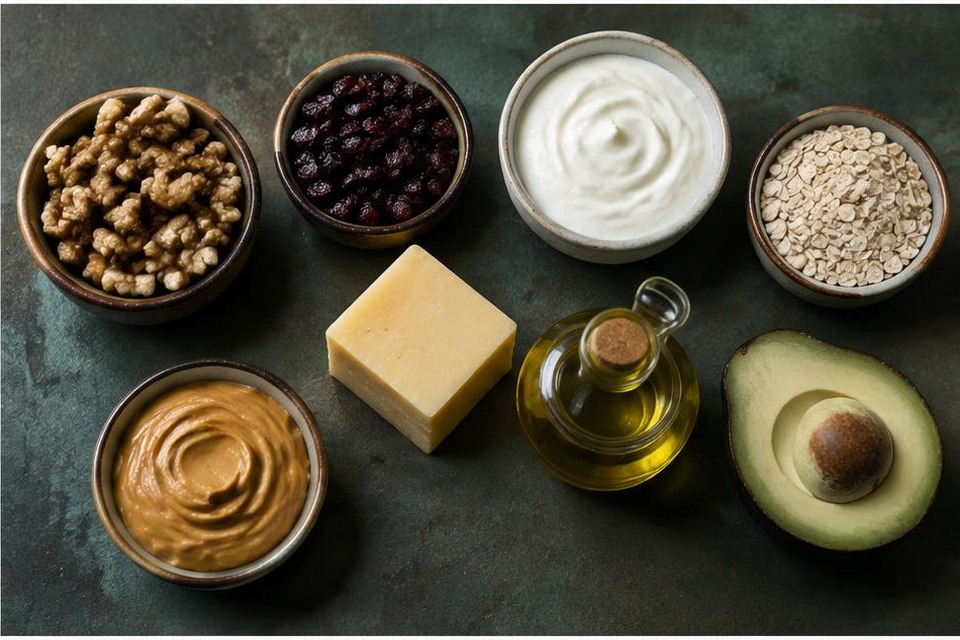
Nuts, dried fruit, yoghurt, oats, cheese, oil and avocado.

How the calculation works

The table uses food records holding energy and protein per 100 g, a CoFID food code and a suggested portion weight. Each record is scaled by its portion weight, with energy rounded to whole calories and protein to one decimal place.

Worked example

The record for Porridge oats, dry lists 381 kcal and 10.9 g protein per 100 g. Its suggested 50 g portion gives 191 kcal and 5.5 g protein. Weigh it in the dry state named in the record.

What the result cannot tell you

These are reference-food figures, not a measurement of your particular product or meal. Suggested portions are examples rather than personal targets. Preparation matters, and adding milk, oil or other ingredients changes the meal total beyond the portion shown.

Common questions

Is the portion column a serving for everyone?

No. It turns an everyday example portion into calories and protein; adjust the amount to your own needs.

Does the oats portion include milk?

No. The record is for dry porridge oats. Count milk and other additions separately.

Why might my packet disagree with the table?

The table uses reference-food records. A branded recipe or different preparation can differ, so use the packet for that product.

Portrait of Chris Mann Dip.IOPN

Written and checked by

Founder & Lead Performance Nutritionist

Chris Mann Dip.IOPN is a sports nutritionist, qualified personal trainer and founder of The Muscle & Strength Hub, with six years of experience helping people build muscle, develop strength and improve their nutrition.

  • Dip.IOPN
  • PN Level 1
  • Level 4 Nutrition
  • Level 3 PT

Certificates and full profileEditorial independenceCorrections

Share this calculator

Free download

Print it or save it to your phone. No email or sign-up. All templates

Free printable · 2 pages · A4

Bulking food reference

Calories and protein for everyday energy-dense foods, from UK government food data, plus a sensible weekly gain.

  • 15 foods with a real portion, calories and protein (CoFID 2021)
  • Weekly weight-gain range for bodyweights from 50 to 110 kg
  • A weekly weigh-in log

Share this template

Was this tool helpful?

Educational information for adults aged 18 and over. It does not diagnose, treat or manage any medical condition. If you have a health condition, or symptoms that worry you, speak to your doctor or a health professional.