Free tool
Incline bench angle visualiser
Slide the bench from flat to 60°. See which part of your chest, or your shoulders, does most of the work at each angle.
Evidence-checkedEdited by Chris Mann Dip.IOPNHow we check thisClose
Every figure and rating this tool shows comes from one set of tested rules, the same ones used across the Hub and our AI tools, with the method and sources named on the page.
Advertising never decides what we write or recommend. If something is wrong, we correct it and record the change.
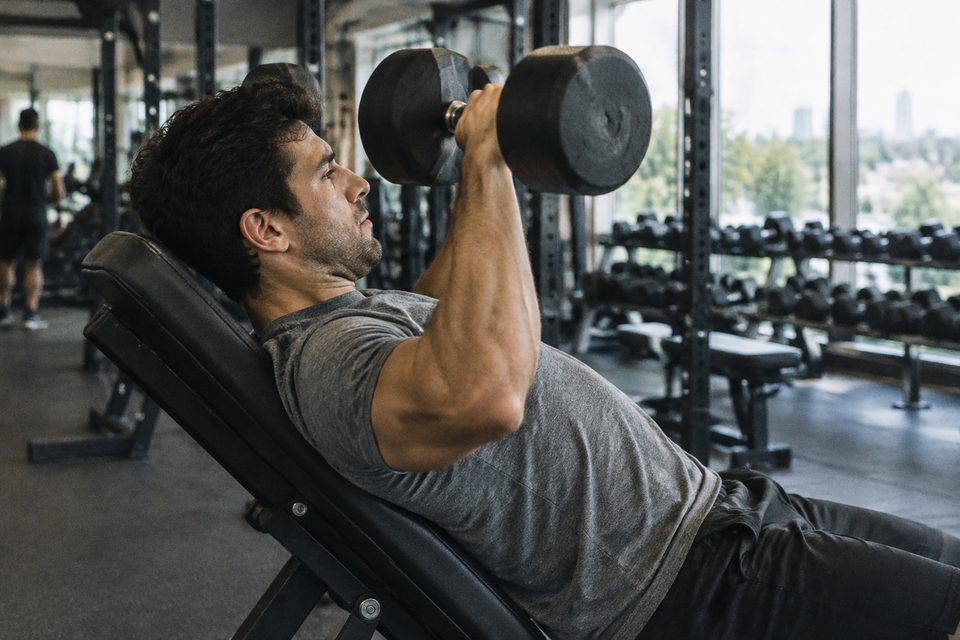
Short answer: Set the incline bench to about 30 degrees for the upper chest. In a study of five angles, the upper chest worked hardest at 30°; from 45° up, the front of the shoulder takes over more of the press.
Studied angle: 30°
Best for upper chest: the upper chest worked hardest here in the five-angle study.
Barbell: lower the bar to the upper chest, just under the collarbones, at any incline.
Find 30° on your gym's bench
Bench notches differ by brand, so measure instead of guessing. Measure the backrest from its hinge to its top end.
- Top end above hinge for 30°
- 40 cm
- 15.7 in
- For your 30°
- 40 cm
- Check: 30°
Bands come from muscle-activity (EMG) studies at five bench angles. They show which muscles work hardest, not exact percentages, and people differ. Nothing you enter is saved or sent anywhere.
What angle should an incline bench be for upper chest?
About 30 degrees. Rodríguez-Ridao and colleagues (2020) measured muscle activity at five bench angles: 0°, 15°, 30°, 45° and 60°. The upper chest worked hardest at 30°. Two earlier studies found the same direction: Lauver et al. (2016) and Trebs et al. (2010).
In those studies, the front of the shoulder did more of the work as the bench got steeper, especially from 45° up.
How many degrees is an incline bench press?
Most incline bench presses are done between 15° and 45°. A low incline (15°) still works mostly the middle and lower chest. 30° is the upper-chest setting. 45° and steeper move the work towards the shoulders, and 60° is closer to a shoulder press.
How do I find 30 degrees on a gym bench?
Notch positions differ from brand to brand, so the notch number alone does not tell you the angle. Measure your backrest from its hinge to its top end, then raise it until the top end sits half that length above the hinge. Half the length gives exactly 30°. The tool works this out for any angle.
What angle should the bench be for incline dumbbell press?
The same: about 30°. Dumbbells let your hands move freely, but the bench angle still decides how much of the press the upper chest does compared with your shoulders.
Is incline bench press better than flat bench?
Neither is better overall. Each one works a different part of the chest most: the flat bench works the middle and lower chest, and a 30° incline works the upper chest. Many programmes use both. To see every muscle a press uses, open the muscle activation explorer. For a full upper-chest plan, read how to build your upper chest.
Frequently asked questions about incline bench angles
Is 30 or 45 degrees better for incline bench?
What does incline bench press work?
Can you do incline and flat bench press on the same day?
Should I arch my back on incline bench press?

Chris Mann Dip.IOPN is a sports nutritionist, qualified personal trainer and founder of The Muscle & Strength Hub, with six years of experience helping people build muscle, develop strength and improve their nutrition.
- Dip.IOPN
- PN Level 1
- Level 4 Nutrition
- Level 3 PT
Certificates and full profileEditorial independenceCorrections
Share this calculator
Was this tool helpful?
Educational information for adults aged 18 and over. It does not diagnose, treat or manage any medical condition. If you have a health condition, or symptoms that worry you, speak to your doctor or a health professional.