Biomechanics & Exercise Science7 min readIntermediate
Stretch-mediated hypertrophy: does training a muscle stretched build more muscle?
Every exercise moves a muscle between long (stretched) and short. Stretch-mediated hypertrophy is the idea that loading a muscle hard while it is long builds more size. Several direct studies now support it, though not for every muscle or exercise.
Share this guide
The short answer
Training a muscle at long lengths often builds more muscle than training it short. Direct comparisons found more growth with seated leg curls, overhead triceps work and standing calf raises (Maeo et al., 2021; Maeo et al., 2023; Kinoshita et al., 2023). The effect is not universal and studies are small, so treat it as a useful guide for choosing exercises rather than a rule.
- Studies are small and mostly in untrained adults, and not every muscle has been tested.
What is stretch-mediated hypertrophy?
Researchers think stretch under load adds a mechanical signal for growth, possibly including new sarcomeres (the units muscle fibres are made of) being added in series. The exact mechanisms in humans are still being studied (Warneke et al., 2023).
Does training at long muscle lengths build more muscle?
Read the full comparisons of seated vs lying leg curls and overhead extensions vs pushdowns.
A review of isometric training found holding contractions at long muscle lengths built more muscle than at short lengths (Oranchuk et al., 2019).
Where the evidence is less certain
- Most studies lasted 8–12 weeks and used small groups.
- Most participants were untrained young adults.
- Some muscles, such as the chest and lats, have little direct evidence.
- Short-length exercises still build muscle; they are not wasted.
How to train muscles in a stretched position
- Pick at least one exercise per muscle that is hardest when the muscle is stretched.
- Use a full, controlled stretch at the bottom of each rep.
- Try lengthened partials at the end of a set if you want more stretch work.
- Choose positions you can control without pain.
Pick stretched-position exercises for each muscle, or read about lengthened partials.
People also ask
Which exercises train muscles at long lengths?
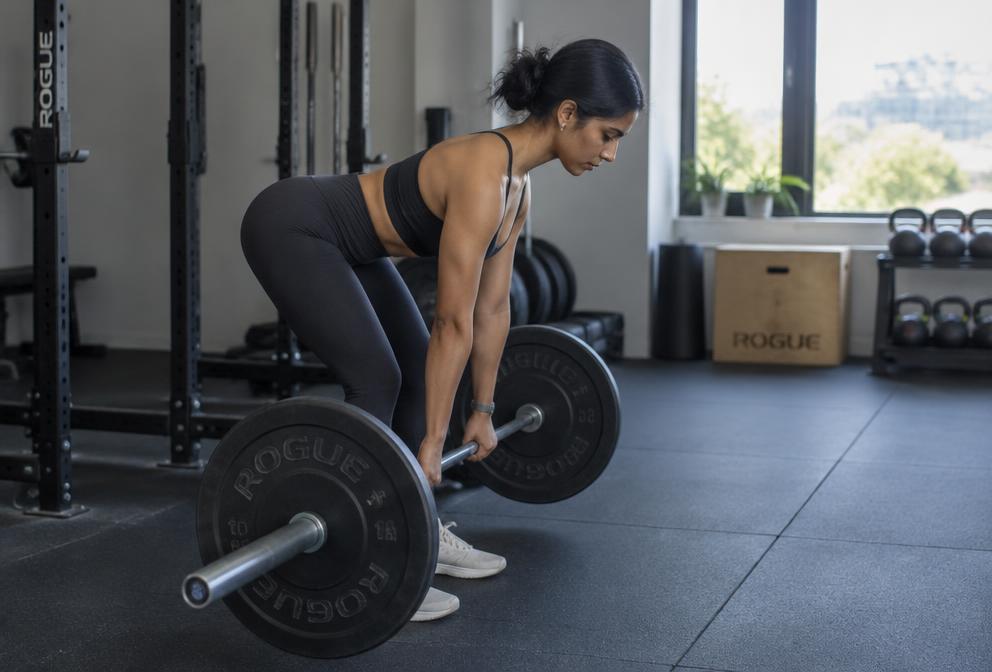
Examples include seated leg curls, overhead triceps extensions, standing calf raises, Romanian deadlifts and deep squats.
Is stretch-mediated hypertrophy real?
Several direct studies support it, but the effect is not universal and studies are small.
Does static stretching build muscle?
Long periods of heavy loaded stretching can, but normal stretching between sets does little for muscle size.
Should every exercise be done at long muscle lengths?
No. Include at least one stretched-position exercise per muscle and keep others you enjoy.
Was this guide helpful?
Scientific References & Evidence
- Kinoshita M. et al. (2023). Triceps surae muscle hypertrophy is greater after standing versus seated calf-raise training. Frontiers in Physiology, 14, 1272106. Available at: https://doi.org/10.3389/fphys.2023.1272106 (Accessed: 23 August 2026).
- Maeo S. et al. (2021). Greater hamstrings muscle hypertrophy but similar damage protection after training at long versus short muscle lengths. Medicine & Science in Sports & Exercise, 53(4), 825–837. Available at: https://doi.org/10.1249/MSS.0000000000002523 (Accessed: 23 August 2026).
- Maeo S. et al. (2023). Triceps brachii hypertrophy is substantially greater after elbow extension training performed in the overhead versus neutral arm position. European Journal of Sport Science, 23(7), 1240–1250. Available at: https://doi.org/10.1080/17461391.2022.2100279 (Accessed: 23 August 2026).
- Oranchuk D. J. et al. (2019). Isometric training and long-term adaptations: effects of muscle length, intensity, and intent. Scandinavian Journal of Medicine & Science in Sports, 29(4), 484–503. Available at: https://doi.org/10.1111/sms.13375 (Accessed: 23 August 2026).
- Warneke K. et al. (2023). Physiology of stretch-mediated hypertrophy and strength increases: a narrative review. Sports Medicine, 53(11), 2055–2075. Available at: https://doi.org/10.1007/s40279-023-01898-x (Accessed: 23 August 2026).
Read next
Lengthened partials: do stretched half reps build more muscle?
What half reps in the stretched part of a lift do for muscle growth, and how to add them.
GuideBiomechanics & Exercise Science6 min readIntermediate
Seated vs lying leg curl: which is better for your hamstrings?
Why the seated leg curl built more hamstring muscle in a direct comparison, and when the lying curl still helps.
Quick answerBiomechanics & Exercise Science5 min readIntermediate
Overhead tricep extension vs pushdown: which builds bigger triceps?
Why overhead triceps work built more muscle than pushdowns, and how to train the long head.
Quick answerBiomechanics & Exercise Science5 min readIntermediate
Educational information for adults aged 18 and over. It does not diagnose, treat or manage any medical condition. If you have a health condition, or symptoms that worry you, speak to your doctor or a health professional.