Nutrition6 min read
Salt tablets for runners: do you need them?
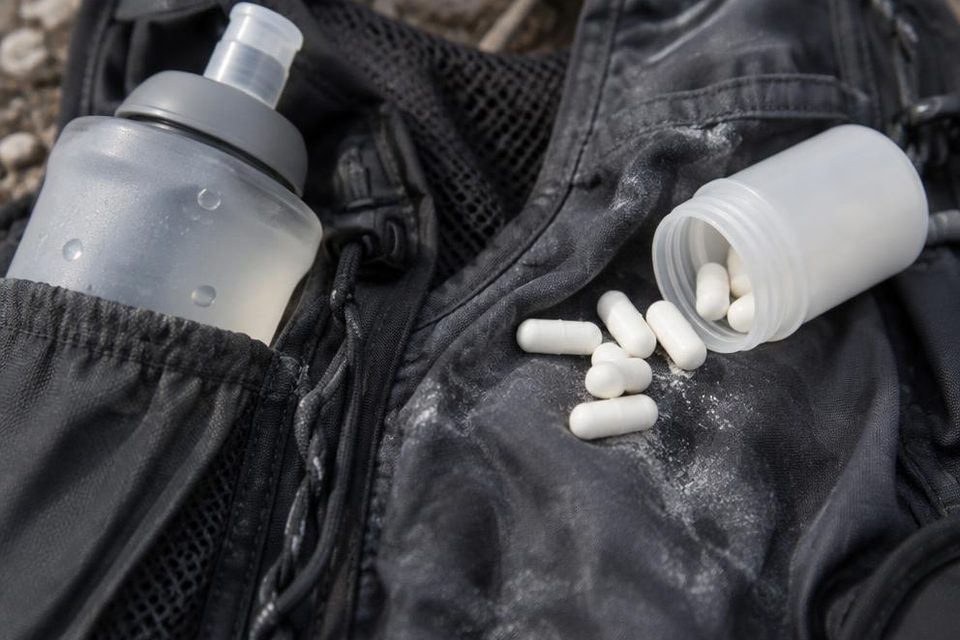
Salt tablets, also called electrolyte capsules, give a measured dose of sodium during long runs. Some runners need them; many get enough sodium from sports drinks, gels and food. Whether you need them depends on how long you run, how much you sweat and how salty your sweat is.
Share this guide
The short answer
Most runners do not need salt tablets for races under about 2 hours. In longer races, especially in the heat, salty sweaters may use them to reach about 460–690 mg of sodium per litre of fluid they drink. Salt tablets do not protect you if you drink far more than you sweat.
- Check your sports drink and gels first: you may already reach your sodium target.
- Practise salt tablets in training, and take them with water.
Do runners need salt tablets?
You are more likely to benefit if you see white salt marks on your kit, your sweat stings your eyes, or you sweat heavily in long, hot races.
How much sodium do you lose in sweat?
The race fuelling calculator gives an hourly sodium figure from your fluid plan and how salty your sweat is. Measure your fluid needs first with the sweat rate calculator.
How many salt tablets should you take in a marathon or Ironman?
Step 1
Find your hourly sodium figure
Use the race fuelling calculator, or aim for about 460–690 mg per litre of fluid you plan to drink (Sawka et al., 2007).
Step 2
Count what you already get
Add up the sodium per hour from your sports drink, gels and chews. The label shows sodium in mg.
Step 3
Fill the gap
Divide the shortfall by the sodium in one tablet. Products differ, so read the label rather than counting tablets.
Step 4
Spread them out
Take them at even intervals with water, not all at once, and practise this on long training runs.
Salt tablets do not prevent hyponatraemia
The international consensus statement identifies drinking more than you sweat as the main cause of low blood sodium during exercise (Hew-Butler et al., 2015). Drink to thirst within your plan and never finish heavier than you started.
Drinking far more than you sweat is more dangerous than losing salt. Read why in our guide to exercise-associated hyponatremia.
People also ask
What do salt tablets do for runners?
They replace some of the sodium lost in sweat during long runs. They do not give energy and do not stop cramps in everyone.
Do salt tablets prevent cramp?
The evidence is mixed. Cramp has several causes, and many runners cramp even with plenty of sodium.
Can I take salt tablets every day?
There is no need on normal days. Most people already eat more salt than they need. Use them only in long, sweaty sessions and races.
Should I take salt tablets if I have high blood pressure?
Ask your doctor first if you have high blood pressure, heart or kidney disease, or take medicines that affect sodium.
Was this guide helpful?
Scientific References & Evidence
- Baker, L.B. (2017) 'Sweating rate and sweat sodium concentration in athletes: a review of methodology and intra/interindividual variability', Sports Medicine, 47(Suppl 1), pp. 111-128. doi: 10.1007/s40279-017-0691-5. Available at: https://doi.org/10.1007/s40279-017-0691-5
- Hew-Butler, T. et al. (2015) 'Statement of the Third International Exercise-Associated Hyponatremia Consensus Development Conference, Carlsbad, California, 2015', Clinical Journal of Sport Medicine, 25(4), pp. 303-320. doi: 10.1097/JSM.0000000000000221. Available at: https://doi.org/10.1097/JSM.0000000000000221
- Hoffman, M.D. and Stuempfle, K.J. (2015) 'Sodium supplementation and exercise-associated hyponatremia during prolonged exercise', Medicine & Science in Sports & Exercise, 47(9), pp. 1781-1787. doi: 10.1249/MSS.0000000000000599. Available at: https://doi.org/10.1249/MSS.0000000000000599
- Sawka, M.N., Burke, L.M., Eichner, E.R., Maughan, R.J., Montain, S.J. and Stachenfeld, N.S. (2007) 'American College of Sports Medicine position stand: exercise and fluid replacement', Medicine & Science in Sports & Exercise, 39(2), pp. 377-390. doi: 10.1249/mss.0b013e31802ca597. Available at: https://doi.org/10.1249/mss.0b013e31802ca597
Read next
Isotonic, hypotonic and hypertonic drinks explained
What the three types of sports drink mean, how they differ and which suits training, racing and recovery.
GuideNutrition6 min read
How to carb load for a marathon
How much carbohydrate to eat before a marathon, for how long, and what a carb-loading day looks like.
GuideNutrition7 min read
Gut training for runners
How to train your stomach to take more carbohydrate during long runs, with a week-by-week plan.
GuideNutrition6 min read
Keto and athletic performance: what the science shows
What low-carb, high-fat diets do to endurance, efficiency and finishing speed.
GuideNutrition6 min read
Educational information for adults aged 18 and over. It does not diagnose, treat or manage any medical condition. If you have a health condition, or symptoms that worry you, speak to your doctor or a health professional.