Free tool
Sweat rate calculator
Find out how much you sweat in an hour, so you can plan how much to drink in training and races.
Short answer: Sweat rate is the weight you lose during a session plus what you drank, minus any urine, divided by the hours you exercised. Each kg lost is about 1 litre of sweat. Aim to lose no more than 2% of your bodyweight, and never finish heavier than you started.
- Sweat rate
- 1,300 ml/h
- 1.30 L of sweat in total
- Bodyweight change
- −1.1%
- Within 2%: a good result
- Drink afterwards
- 1,000–1,200 ml
- 125–150% of what you lost, over the next few hours, with some salt
- Sodium lost (estimate)
- 1,200 mg
- From typical sweat sodium values; yours may differ
Repeat the test in the weather and at the pace you expect on race day: sweat rate changes with both. Enter your sweat rate in the race fuelling calculator for a personal drinking plan. Never finish heavier than you started. Nothing you enter is saved or sent anywhere.
How to calculate your sweat rate
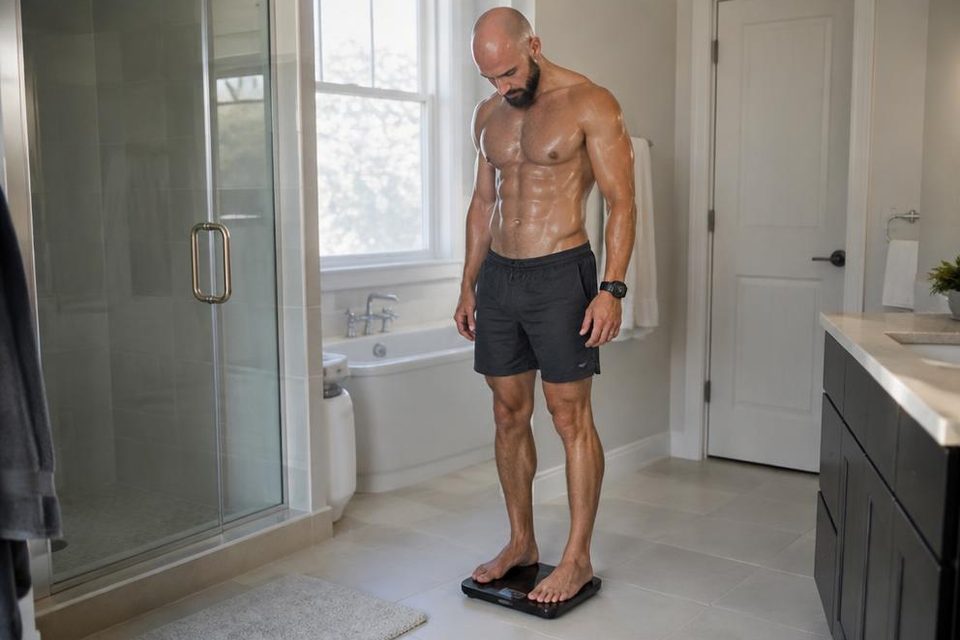
Weigh yourself naked before and after a session. Add the fluid you drank and take away any urine you passed. Divide by the hours you exercised. A 1 kg loss is about 1 litre of sweat (Sawka et al., 2007).
Example: you lose 1 kg and drink 500 ml in one hour. Your sweat rate is 1.5 litres an hour.
How much should you drink when running?
The American College of Sports Medicine advises drinking enough to keep weight loss under 2% of bodyweight, without gaining weight (Sawka et al., 2007). You do not need to replace every drop. Most runners land between 400 and 800 ml an hour.
Why sweat rates differ so much
Sweat rate and salt loss vary widely between athletes, and for the same athlete with heat, humidity, pace and fitness (Baker, 2017). Test in conditions close to your race and repeat the test as the seasons change.
Rehydrating after exercise
Drink about 1.5 litres for every kg lost over the next few hours, with some salt from food or drink, to replace what you lost (Sawka et al., 2007).
Safety: do not overdrink
If you finish heavier than you started, you drank more than you sweated. In long events this can lead to low blood sodium (hyponatraemia), which can be serious (Hew-Butler et al., 2015). If you feel confused, very bloated or have a worsening headache, get medical help.
Scientific sources
- Sawka M. N. et al. (2007). American College of Sports Medicine position stand: exercise and fluid replacement. Medicine & Science in Sports & Exercise, 39(2), 377–390.
- Baker L. B. (2017). Sweating rate and sweat sodium concentration in athletes: a review of methodology and intra/interindividual variability. Sports Medicine, 47(Suppl 1), 111–128.
- Hew-Butler T. et al. (2015). Statement of the Third International Exercise-Associated Hyponatremia Consensus Development Conference. Clinical Journal of Sport Medicine, 25(4), 303–320.
More endurance tools and guides: Sports nutrition, including the race fuelling and hydration calculator.
Embed this calculator on your website
Free for coaches, gyms and writers. Paste this code into your page; it stays up to date automatically.
Share this calculator
Was this tool helpful?
Educational information for adults aged 18 and over. It does not diagnose, treat or manage any medical condition. If you have a health condition, or symptoms that worry you, speak to your doctor or a health professional.