Nutrition6 min read
Isotonic, hypotonic and hypertonic drinks explained
Sports drinks are grouped by how concentrated they are compared with your body fluids. That concentration, called osmolality, mostly depends on how much sugar and salt is dissolved in the drink. It affects how quickly fluid leaves your stomach and how much energy you get.
Share this guide
The short answer
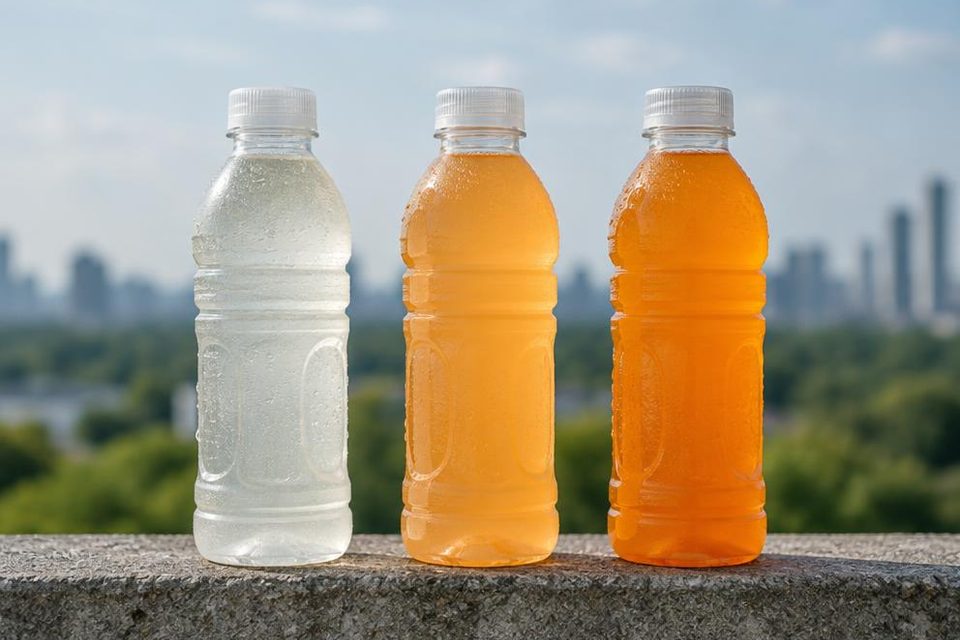
Isotonic drinks have about the same concentration as your body fluids and usually 6–8 g of carbohydrate per 100 ml, giving fluid and energy together. Hypotonic drinks are more dilute and mainly replace fluid. Hypertonic drinks are more concentrated, giving lots of energy but little fluid, and are best for recovery or alongside water.
- ACSM guidance recommends drinks with 4–8% carbohydrate and sodium during long exercise (Sawka et al., 2007).
- Gels are very concentrated: take them with water, not with a strong sports drink.
Isotonic vs hypotonic vs hypertonic: the differences
| Type | Carbohydrate per 100 ml | Main job | Best used |
|---|---|---|---|
| Hypotonic | Under about 6 g | Fluid | Shorter or hot sessions where fluid matters more than fuel |
| Isotonic | About 6–8 g | Fluid and energy | Long runs, rides and races |
| Hypertonic | Over about 8 g | Energy | Recovery, or with water during long events |
What is an isotonic drink?
An isotonic drink has a similar concentration to your blood, so fluid and carbohydrate are absorbed well together. For a drink to carry the permitted claim that it helps maintain endurance performance and improves water absorption in Great Britain and the EU, it must meet set conditions, including 80–350 kcal per litre, most energy from high-glycaemic carbohydrate, 460–1,150 mg of sodium per litre and an osmolality of 200–330 mOsm/kg (European Commission, 2012).
At 6 g per 100 ml, 500 ml of an isotonic drink gives about 30 g of carbohydrate, around one gel's worth. Plan the rest of your hourly carbohydrate with the carbs per hour calculator.
What is a hypotonic drink?
A hypotonic drink is more dilute than your body fluids. Many electrolyte tablets dissolved in water are hypotonic: they give sodium and fluid with little or no carbohydrate. They suit shorter sessions, hot days or runners who take their carbohydrate from gels.
What is a hypertonic drink?
A hypertonic drink is more concentrated than your body fluids. Fruit juice, regular cola and some high-carbohydrate drinks are hypertonic. They give lots of energy but empty from the stomach more slowly, and can cause bloating if drunk alone in hard exercise. They are useful after exercise to refuel quickly, or during long events alongside water.
Energy gels are very concentrated too. Take them with plain water to avoid stomach trouble, and train your gut to handle them.
Which sports drink should you use?
- Under an hour: water is usually enough.
- Long, hot races: add sodium from drinks or gels, or see salt tablets for runners.
- One to two hours: an isotonic drink, or a hypotonic drink with a gel.
- Over two hours: isotonic drink plus gels or chews taken with water, to reach your carbs per hour (Jeukendrup, 2014).
- After exercise: any of the three, with food, to replace fluid and carbohydrate.
Use the recovery nutrition calculator for what to have after a long session.
For hard efforts of about an hour, a carbohydrate mouth rinse is another way to use a sports drink.
People also ask
Is isotonic or hypotonic better for running?
For long runs, isotonic gives fluid and energy together. Hypotonic suits shorter or hot runs, or when you take carbohydrate from gels.
Is coconut water isotonic?
It is often described that way, but it is low in sodium compared with sports drinks. Check the label if you need sodium.
Can I make my own isotonic drink?
Yes. Diluted squash or juice with a small pinch of salt can work. Aim for about 6–8 g of carbohydrate per 100 ml.
Are hypertonic drinks bad?
No. They are useful for energy, but drink water with them during hard exercise so your stomach copes.
Was this guide helpful?
Scientific References & Evidence
- European Commission (2012) Commission Regulation (EU) No 432/2012 establishing a list of permitted health claims made on foods. Official Journal of the European Union, L 136, pp. 1-40. Available at: https://eur-lex.europa.eu/eli/reg/2012/432/oj
- Jeukendrup, A. (2014) 'A step towards personalized sports nutrition: carbohydrate intake during exercise', Sports Medicine, 44(Suppl 1), pp. S25-S33. doi: 10.1007/s40279-014-0148-z. Available at: https://doi.org/10.1007/s40279-014-0148-z
- Sawka, M.N., Burke, L.M., Eichner, E.R., Maughan, R.J., Montain, S.J. and Stachenfeld, N.S. (2007) 'American College of Sports Medicine position stand: exercise and fluid replacement', Medicine & Science in Sports & Exercise, 39(2), pp. 377-390. doi: 10.1249/mss.0b013e31802ca597. Available at: https://doi.org/10.1249/mss.0b013e31802ca597
Read next
Salt tablets for runners: do you need them?
Who needs salt tablets, how much sodium to aim for, and why they do not prevent the effects of overdrinking.
GuideNutrition6 min read
Gut training for runners
How to train your stomach to take more carbohydrate during long runs, with a week-by-week plan.
GuideNutrition6 min read
How to carb load for a marathon
How much carbohydrate to eat before a marathon, for how long, and what a carb-loading day looks like.
GuideNutrition7 min read
Keto and athletic performance: what the science shows
What low-carb, high-fat diets do to endurance, efficiency and finishing speed.
GuideNutrition6 min read
Educational information for adults aged 18 and over. It does not diagnose, treat or manage any medical condition. If you have a health condition, or symptoms that worry you, speak to your doctor or a health professional.