Nutrition6 min read
Keto and athletic performance: what the science shows
A ketogenic diet trains your body to burn much more fat during exercise. That sounds ideal for long races, where fat stores are almost limitless. But controlled trials in elite endurance athletes found the trade-off: you become less efficient, and the fast efforts that win races get harder.
Share this guide
The short answer
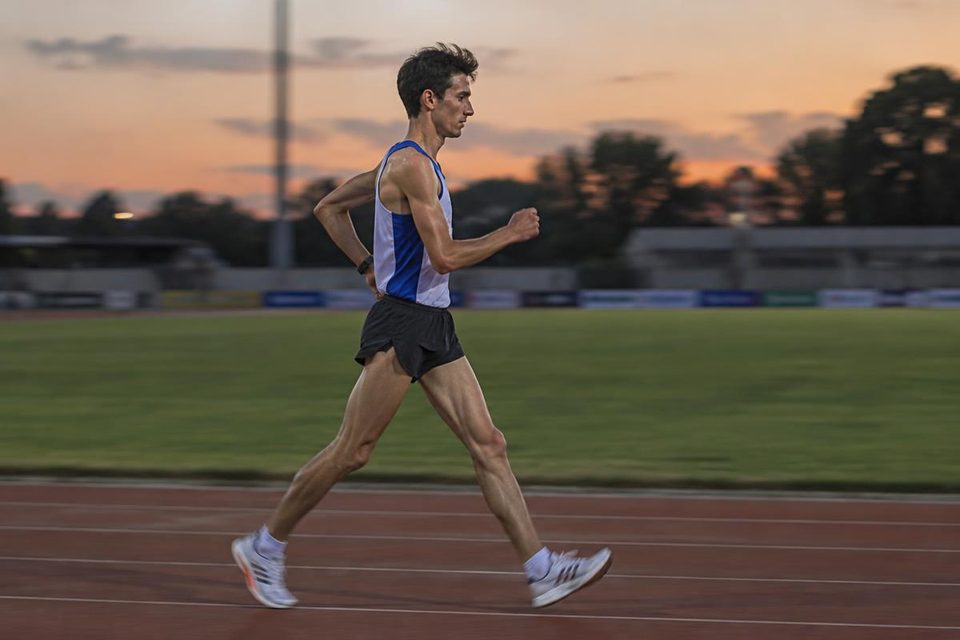
Keto usually makes endurance performance worse, not better. In elite race walkers, a ketogenic diet more than doubled fat burning but raised the oxygen cost of race pace, and their race times did not improve while athletes eating carbohydrate got faster (Burke et al., 2017; 2020). Keto also reduces your ability to use carbohydrate for surges and sprint finishes.
- Fat adaptation reduced sprint power late in a long time trial (Havemann et al., 2006).
- For building muscle in the gym, see the separate guide on keto and muscle building.
Does keto hurt running performance?
Why keto takes away your top gear
Hard surges, hill climbs and sprint finishes run mostly on carbohydrate. After fat adaptation, muscles became less able to use carbohydrate: the enzyme pyruvate dehydrogenase (PDH), which controls carbohydrate use, was less active during exercise, even when carbohydrate was eaten again (Stellingwerff et al., 2006).
Keto for runners: is there any case for it?
- Very long, slow events where speed matters less may suffer less, but evidence of a benefit is weak.
- Some people prefer low-carb eating for appetite or weight reasons; expect slower hard sessions.
- If you have diabetes or take medicines, speak to your GP before cutting carbohydrate.
For lifting and muscle growth, read keto and muscle building.
What to eat instead of keto for endurance
Match carbohydrate to your training, eating more on hard days and less on easy days (Thomas, Erdman and Burke, 2016). Plan your week with the carbohydrate periodisation calculator and your race with a carbs-per-hour plan.
People also ask
Is keto good for marathon running?
The best trials say no for racing: keto made elite athletes less efficient, and their times did not improve.
Does fat adaptation help endurance?
It increases fat burning, but it also reduces your ability to use carbohydrate for hard efforts.
Does keto improve fat burning?
Yes, a lot, but burning more fat did not make elite athletes faster (Burke et al., 2017).
Can I carb load after keto?
Carb loading after fat adaptation still left sprint power lower in one trial.
Was this guide helpful?
Scientific References & Evidence
- Burke, L.M., Ross, M.L., Garvican-Lewis, L.A., Welvaert, M., Heikura, I.A., Forbes, S.G., Mirtschin, J.G., Cato, L.E., Strobel, N., Sharma, A.P. and Hawley, J.A. (2017) 'Low carbohydrate, high fat diet impairs exercise economy and negates the performance benefit from intensified training in elite race walkers', The Journal of Physiology, 595(9), pp. 2785-2807. doi: 10.1113/JP273230. Available at: https://doi.org/10.1113/JP273230
- Burke, L.M., Sharma, A.P., Heikura, I.A., Forbes, S.F., Holloway, M., McKay, A.K.A., Bone, J.L., Leckey, J.J., Welvaert, M. and Ross, M.L. (2020) 'Crisis of confidence averted: Impairment of exercise economy and performance in elite race walkers by ketogenic low carbohydrate, high fat (LCHF) diet is reproducible', PLOS ONE, 15(6), e0234027. doi: 10.1371/journal.pone.0234027. Available at: https://doi.org/10.1371/journal.pone.0234027
- Havemann, L., West, S.J., Goedecke, J.H., Macdonald, I.A., St Clair Gibson, A., Noakes, T.D. and Lambert, E.V. (2006) 'Fat adaptation followed by carbohydrate loading compromises high-intensity sprint performance', Journal of Applied Physiology, 100(1), pp. 194-202. doi: 10.1152/japplphysiol.00813.2005. Available at: https://doi.org/10.1152/japplphysiol.00813.2005
- Stellingwerff, T., Spriet, L.L., Watt, M.J., Kimber, N.E., Hargreaves, M., Hawley, J.A. and Burke, L.M. (2006) 'Decreased PDH activation and glycogenolysis during exercise following fat adaptation with carbohydrate restoration', American Journal of Physiology-Endocrinology and Metabolism, 290(2), pp. E380-E388. doi: 10.1152/ajpendo.00268.2005. Available at: https://doi.org/10.1152/ajpendo.00268.2005
- Thomas, D.T., Erdman, K.A. and Burke, L.M. (2016) 'Nutrition and athletic performance', Medicine & Science in Sports & Exercise, 48(3), pp. 543-568. doi: 10.1249/MSS.0000000000000852. Available at: https://doi.org/10.1249/MSS.0000000000000852
Read next
Can you build muscle on keto?
What trials in lifters show about keto, muscle growth, strength and high-volume gym training.
GuideNutrition7 min read
How to carb load for a marathon
How much carbohydrate to eat before a marathon, for how long, and what a carb-loading day looks like.
GuideNutrition7 min read
Salt tablets for runners: do you need them?
Who needs salt tablets, how much sodium to aim for, and why they do not prevent the effects of overdrinking.
GuideNutrition6 min read
Isotonic, hypotonic and hypertonic drinks explained
What the three types of sports drink mean, how they differ and which suits training, racing and recovery.
GuideNutrition6 min read
Educational information for adults aged 18 and over. It does not diagnose, treat or manage any medical condition. If you have a health condition, or symptoms that worry you, speak to your doctor or a health professional.